SPECIAL OFFER • BUY 3 OR MORE, GET 3% OFF - USE CODE FUN3 • BUY 5 OR MORE, GET 5% OFF - USE CODE FUN5

SPECIAL OFFER - BUY 3 OR MORE, GET 3% OFF WITH CODE FUN3, BUY 5 OR MORE, GET 5% OFF WITH CODE FUN5

Sands Of Adventure Indiana Jones Review
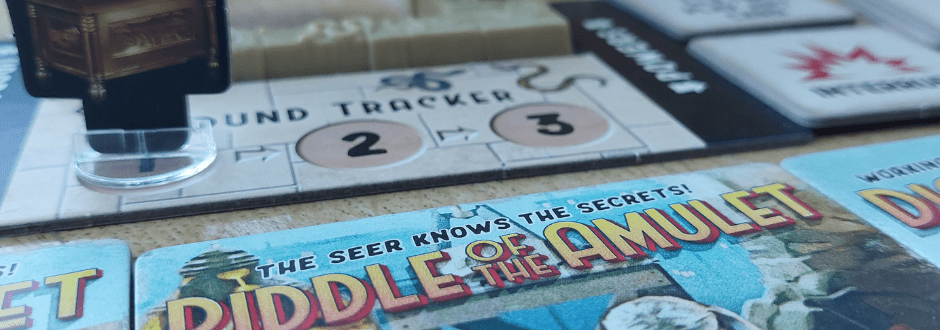
Time is running out! Hurry up, Indie!!! Or rather, hurry up everyone! Because in Indiana Jones Sands of Adventure, we are taking on well-loved characters from the brilliant adventure franchise to work together and rescue the Ark of the Covenant before it falls into the wrong hands!

Family Fun

This is a fast playing, strategic, hand management, real-time, push-your-luck, deck building, pattern matching, action selection, worker placement, asymmetrical ability game that is really fun! And if that sounds like a lot to pack in, it is! But they all work really well together.

Played over 3 rounds, essentially what you and up to 3 other players (age 8+) are doing each round is finding a way to reduce the active Villain(s)’ health to zero before the time runs out. You do that by working together to lay attack-based action/upgrade cards down and knocking them back hit point after hit point. But, in almost trick-taking style, you can only lay a card that matches the colour or symbol of the card laid before it. So as a team you need to co-ordinate who has what and who is going to lay what when! And that’s all quite cool, calm and collected during the turn-based part of the round.

During that part, you decide which action is best for your character to activate, bearing in mind their asymmetric ability and that of the Villain’s. You move your character to that tile, activate the action, and then roll one or two threat dice. If the threat dice reveal gems, you have to add them to the top basket of the sand timer. If they reveal an “X”, you have to activate the nefarious Villain’s meanie power! Round one introduces Colonel Deitrich, then round two has Major Toht, and then finally round three welcomes Dr Rene Belloq. And each starts with more health than the previous one….so you know it’s building up to the big boss battle at the end!

But then suddenly, when the sand timer gem basket reaches critical point and swings, play moves into the real-time phase and everything starts going at super-speed! Players still need to lay cards in turn, but now when players stop laying cards they can draw a new action card off the deck…and that might just be the vital linking colour/symbol or another attack card! So the game becomes a fast synapse sizzling session with split second decisions over when to stop laying cards and pass over to the next player!

When a snake card is drawn in the real-time phase, the active player has to roll the red dice and the next player can then only start laying cards if the torch symbol is rolled! If you have been canny during phase one and collected a power token that allows you to ignore the snake (or interrupt another player’s turn or play any card), then this might not slow you down. Otherwise, everyone round the table starts chanting “come ooonnnnnn” as torch after torch gets missed!

If you defeat the Villain before the sand timer runs out they get sent away and the game is reset in readiness for the next one including swapping in a new action tile (although note that any upgrade cards played to the action deck are retained in a light but very effective nod to deck building!!). If you don’t defeat Deitrich or Toht, however, you’ll face a double or triple battle in round 3! It’s wild! Haha

Final Thoughts

We have an absolute blast playing this game. It’s fun, and the artwork really does bring back great memories of the Indiana Jones films I watched as a kid (and still do!) But it’s also hiding some really neat tricks up its sandy sleeves. It’s also a brilliant game to play with the family. We played as a 2 and also with our 8 year old son and each time it has been great. He loves filling the basket with gems and watching the sand timer slide down. At the moment, we do a bit more of the real-time coordination to help the team through but he’s super smart and considers each action spot carefully on every turn. It won’t be long before he is telling us we are slowing him down! haha

The components are also really nice and evocative of the Indian Jones films and the giant and timer works really well – it suddenly tips and swings and everyone suddenly races into action to try and co-ordinate colours and icons on cards in a chain effect to try and get those villains gone!

Sands of Adventure is easy to learn, fun to play, and a brilliant mix of mechanics. We love the switch between calm and chaos and it’s definitely a game that makes us enjoy co-operative gaming as a family!!

This blog was written by Favouritefoe
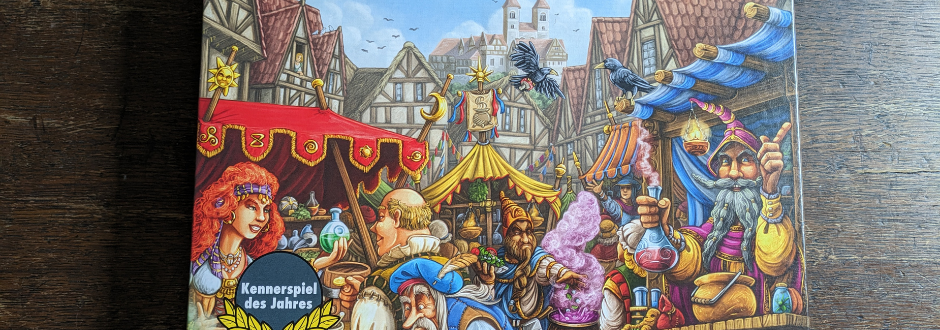
Quacks Of Quedlinburg Review

The game you love to say the name of but hate to spell. Welcome to Quedlinburg, just beware the dodgy Doctors selling their potions. Oh, you want to set up shop too? Then by all means go ahead, I’m sure you’re the real deal, not like all these Quacks.

Ready, Steady, Brew!

In Quacks of Quedlinburg you are brewing potions, but in a rather haphazard manner. You have a bag of ingredients and you randomly put your hand in during your turn and keep adding whatever you pull out to your potion. Push your luck too much, pull the wrong ingredients and your potion explodes! Stop at the right time and you might just win some points and get some more ingredients for next time. Whoever has the most points at the end of the 9th turn, wins.

Preparing Your Ingredients

At the start of the game everyone starts with a few basic ingredients, including several bad ones. If the numbers on these bad ones, when placed into your potion, ever add up to more than 7, your potion explodes. All the rest of the ingredients are useful though, and which ones you try and place in your potion will depend entirely on your strategy. The game comes with several ingredient books which describe the abilities and costs of each ingredient, and associated ingredient counters. Some might cost more but are more powerful, while some might cost barely anything, but not do much at all, filler if you will. Never underestimate the usefulness of filler though when you are working out the probability of pulling bad ingredients out of your bag.

The ingredient books can be set up in different combinations and using different sides of the card that change the ingredient abilities based on how difficult a game you want. For your first few games it’s definitely worth playing the basic list before mixing it up. There is also a flask which lets you put an ingredient back in the bag if you draw really poorly, but only if it wouldn’t otherwise make your potion explode, and it’s a one use thing that has to be re-purchased. Oh and if you get too far behind, don’t worry, drop some rat tails into your potion. Gross, sure, but the further you are behind the more rat tails start in your potion, meaning you start further around the track and are more likely to score better.

It Didn’t Explode, Huzzah!

When everyone has either finished drawing from their bags or their potions have exploded, the evaluation phase begins. First the person with the highest scoring potion gets to roll the bonus dice to gain an advantage, but only if their potion didn’t explode. The main part of this phase however is the scoring. Based on how far down you got on the ingredient track in the potion, you gain a certain number of scoring points and other points to buy more ingredients. Crucially though, those whose potions exploded, have to either gain scoring points or buy more ingredients, a difficult choice for sure, but a good balance I feel to make the potion exploding not feel too bad.

From there, you continue through the turns, gaining more ingredients and hopefully brewing more and more successful potions. Luck definitely comes into it, for example I was a decent amount ahead on the last turn one game, with a lot of ingredients in my bag, and I managed to pull all the bad ingredients on my final turn with barely any others. Insanely bad luck for sure and feels a little bad, but not too much. I was still able to keep what scoring points I did manage to get and held onto second place.

Conclusion

I honestly would recommend Quacks of Quedlinburg to anyone. It’s a really solid game with a fun theme that is reasonably easy to teach anyone, even those who are new to board games in general. The luck element is well balanced with what you can do to offset it by buying different ingredients, and even if your potion explodes, you don’t lose out on everything, just some extras. I do wish the ingredient components were a bit easier to pick up, but that’s probably just me. There are also quite a lot of small components, so if you have younger children, best keep an eye out. I would highly recommend anyone to give it a go though as it’s a fantastic game. There are even two expansions, Herb Witches and The Alchemists, for when you feel like you’ve got everything out of it, but it’s a highly replayable game so that will take a while. There is even a mega box if you want to go all in!

This blog was written by Ross Coulbeck

Rustling Leaves Review

Just Keep Rollin’ Rollin’ Rollin’

Over the last five years ‘roll and writes’ have become incredibly popular. Since the explosion onto the scene of games like Railroad Ink in 2018 this new genre seems to have taken over the market. Even big board games have released roll and write versions with the heaviest of them all, Twilight Imperium bringing out its own this year. But what is a ‘roll and write’? In its purest form it is a puzzle to solve with the placement of numbers or symbols rolled on a dice. The aforementioned Railroad Ink sees you place railway lines or roads in order to connect the sides of a grid. Cartographers (although technically a flip and write) sees you draw different terrain types on a custom map in order to score points for different configurations. Or Rolling Realms, Stonemaier’s living roll and right which asks you to place numbers on a variety or cards inspired by other board games to get as many stars as possible. But one thing most of them have in common is they are pretty relaxing and meditative activities that have very little, if any, interaction.

Woodland Wanderer

In 2020’s Rustling Leaves, designer Paolo Mori (of Libertalia fame) takes you for a gentle walk through the woods. On your sheet, a grid of different, animal, flower and insect icons you will draw different sized boxes in order to score points for the configurations labeled below. For example, for every pair of birds you have in a box you will get five points. Or every bumblebee will score you differently depending on how many purple flowers you have. However, bears don’t want to be boxed in so only score those who still roam free by the end of the game. But how do you decide what boxes to draw? In the box you get two custom dice. When you roll the dice you will draw a grid using the two numbers shown. Roll a one and a three and draw a one by three box. The only condition is that each box must be connected to another. There are also sides of the dice with clouds on. When you roll those you mark off a cloud and the more you get the more they will pay off. When does it end? Whenever you want it to. As soon as you are happy you have scored all that you can then stop because if you roll and can’t place a box then you will lose points for each that you have to or choose to pass.

Winter, Spring, Summer Or Fall, All You Have To Do Is Roll…

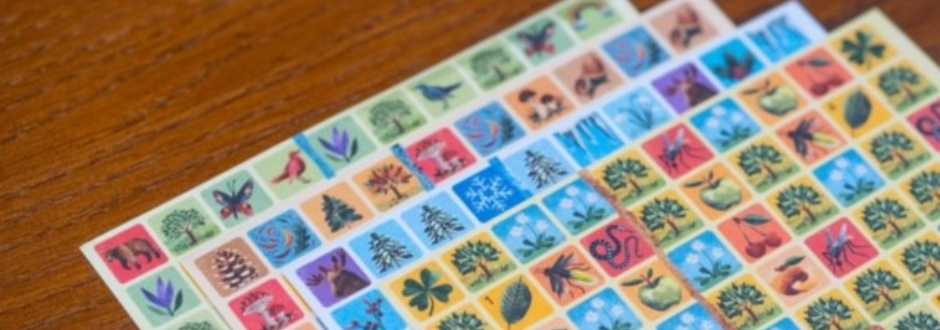
When you first pick this box up, the surprise will be just how heavy it is. This is because it comes with a huge pad of sheets which come in four different flavours. You will get a grid for each season of the year and each one will have different icons and will score very differently. The game suggests you play through all four and then take the final score but I find this game shines the best when you just pull a random sheet and dive into a short, chilled out game. It’s a bit of a shame that the game didn’t think to offer laminated versions with white board pens. Considering this is a game about the beauty of the natural world, it feels very shortsighted to be wasting so much paper in their box. But that is a minor quibble. You could in fact laminate your own and buy a few small pens to make it a most sustainable game without worry of running out of sheets.

Rustling Leaves is a beautiful looking and completely chilled out game which will make you think enough to justify the activity without ever exhausting you. The scoring can get a little ‘mathy’ sometimes so those who run to the hills at the thought of mathematics may need to take a deep breath before attempting to score. That said, as the title suggests, this is the perfect chill out game to keep in your bag and pull out when out for a picnic or on holiday or even at the pub with a nice cool glass of wine. And any game that pairs well with a cold Sauvignon Blanc on a hot summer’s day is a thumbs up from me!

This blog was written by Dan Street Phillips

Diamant Review

It’s always hard to find games that will play up to a large player count. Sometimes the standard 4-6 just won’t satisfy a family get together and so Diamant comes to the rescue. Published in 2005, and designed by Alan R. Moon (of Ticket to Ride fame) and Bruno Faidutti, Diamant is a direct response (according to the designers) to the classic push your luck game Can’t Stop. So how does it work?

Cave Diving

The premise of Diamant is you are exploring five caves in order to find precious rubies! However, to no surprise for those Indiana Jones fans in the room, in the caves are a number of dangerous things to avoid. Each round you will reveal an exploration tile which will show one of three things. First there are rubies. Rubies are shiny. Rubies are points! And in this version they are lovely, tactile little plastic red shards. But this is a democracy. If a tile shows a number of rubies, you will have to decide your boon equally between your team. If there are any left over then you have to leave them on the path, that’s the fairest thing after all. But if you are sneaky, you might be able to pick some of them up as you make your way back to camp. At the end of each round the group will vote whether they want to continue into the cave and reveal the next card or whether they want to take what they have and go back to the safety of the camp. Why would you go back? If you are the only one to go back then you will get all of the rubies left of the path. However, if there are multiple team members heading back to the campfire then the rubies must be divided again leaving any left over on the path for someone else.

Not Snakes! I Hate Snakes!

The next set of tiles you could draw are threats. There are snakes, spiders, traps, rolling boulders and lava and if you ever encounter two of the same threat at any point in your exploration, you will drop all that you have collected as you flee for your life. As only rubies that make it back to your cute little cardboard treasure chest at camp will count at the end, knowing when to run is pivotal to your success in the game. There is a fantastic tension throughout the game when threats are revealed. It is a simple mechanism but when that first of a kind is revealed there is so much fear! Pushing your luck as more threats come out feels truly exciting and watching someone go deeper and deeper only to bust and lose dozens of rubies is so much fun!

My Precious

The final type of tile is a relic. A new relic will be added in each round and so if it doesn’t come out during a round, there is more and more chance of finding one later in the game. These can be worth a lot of points, especially those added in the later rounds. However in order to steal a relic you have to be the only one turning back on that turn. If anyone else decides to leave with you then your conscience won’t allow you to steal such a beautiful relic. However, on your own, morals are gone! I love this little addition that can really tempt you to leave, especially early on when most people will want to continue.

The history of this game is filled with different versions published around the world. Known also as Incan Gold under another publication, the games are almost identical with only a few minor differences. The biggest difference is the presentation of the camp. In Incan Gold, you have a little folded bits of cardboard representing tents to hide your rubies in whereas Diamant comes with little chests. I love the chests! Made of foam core they slot together quite easily but may need a little glue as sometimes have a tendency of slipping apart. But there is something really tactile and fun and collecting your rubies and hiding them from prying eyes.

I have played this with young children, teenagers and adults of all ages and everyone has had a great time. It is so fast paced and exciting that games fly by and people want to play over and over again. Next time you have a family gathering, grab that fedora and whip and head on down into the caves as you don’t know what you are going to find!

This blog was wirtten by Dan Street Phillips

Jenga Review

I can already feel my palms sweating! Haha If you haven’t played Jenga before, it’s a tower building game. Actually I think it could also be called a tower falling down game, or at least that’s what happens when I play!

It’s a super simple idea; You start the game with a tower constructed of 54 solid wooden blocks , 18 levels high. 3 blocks form each level and alternate in pattern. As such, the next layer is laid perpendicular the to blocks below it.

The objective is to be the person who placed the piece before the tower was razed to the ground!

Players take it in turns to use one hand to relocate a block from a lower level and place it on the very top of the tower. Once in situ, the next player takes their turn and around it goes until the tower buckles, and they all fall down! Or a significant amount of them!

Tumbling Towers

The great thing about Jenga is that you can play it straight out of the box. Whilst it has to begin with a story placed 18 levels high, the only way to pack the game back into the box is to stack the pieces in their formation. And with a handy plastic insert inside the box, it means that the game is ready to go (so long as someone with a steady hand slides it out!)

Final Thoughts

We play Jenga a lot. As a family, as grown-ups with friends (I will neither admit nor deny whether alcoholic beverages are consumed during said grown-up games!), as a team-building exercise, and I’ve even played it by myself!

Pushing a piece from the middle of each row is where most early turns begin. On their own, they’re unlikely to cause storey-instability, and start to get the tower up pretty high. But of course the effect is cumulative. If every level had the centre block removed, the next turn after would cause the tower to fall. Believe me, I learned that the hard way! Haha

Similarly, if everyone takes pieces from one side, that tower will not stand the test of time! As such, where you move your piece can be as much about mitigating the previous players’ foolhardiness as it is about finding a spot for your piece that will be the architect of the next player’s misfortune!

This game can get really tense in the best possible way! Watching the tower lean like Pisa’s famous landmark, and then tilt back thanks to some canny counterweight is looking-through-your-fingers, baring your teeth intensity! Breathing stops. Hands shake. Shoulders rise…….it’s brilliant!

I’ve had more can’t look-must look moments playing this game than any other!

It’s such a simple idea and it’s one of those games where as soon as you suggest it everyone wants to join in or watch it being played. It’s like looking at fire. You can’t draw your eyes away as pieces are wibbly wobblied out and then placed precariously on top!

Plus it’s a great teaching tool – this game is physics parading as a game! Our 8 year old learns more about balance, structural strength, and gravitational forces through Jenga than his school books!

We really enjoy Jenga and I don’t think it will ever leave our collection!

This blog was written by Favouritefoe
Monopoly Deal Review

Monopoly is one of the most, if not the most, famous board games ever. But sometimes it really can drag on can’t it? What if I told you that you can get all the same fun, but in 15 mins and a small card game? Are you excited? Because in my humble opinion you really should be! Enter Monopoly Deal, the card game with all the fun and drama of Monopoly but without any player elimination or table flipping.

Pray What Is This Quick Monopoly Of Which You Speak?

Monopoly Deal is a card game where you will be doing the familiar trope of collecting sets of houses in the same colour, charging your fellow players rent on them, and if they cannot pay then like the ruthless landlord that you are, you will steal their properties from them in lieu of cash payment and keep them as your own. Sounds just as nasty as the original game, but all over a lot quicker, which in my mind is a great thing.

How Do You Play Monopoly Deal?

The aim of the game is to collect 3 complete sets of properties in order to win. On your turn you will draw cards, and then play up to three cards down. There are money cards, which are simply worth cash. It is important to have a buffer of some money in the bank in case you have to pay for someone’s birthday gift or rent at Liverpool Street station. There are also the property cards, playing these down is essential to winning, but as soon as you play cards down they become a target that your opponents will be eyeing up hungrily and plotting to steal. You also have action cards that will let you draw more cards, charge fellow players rent or steal their properties from right under their nose.

You will spend the game balancing playing down cards to get yourself closer to victory and plotting the demise of your fellow players and trying to engineer a master stroke turn where you steal everything from them. Just at the right time ideally so that you may also win. These grand plans can of course be thwarted if they have a “just say no” card. Consent is important, and you must bow down to the regal Just Say No card, although it really hurts when they crush your capitalist dreams this way.

Who Is This Suitable For?

If you want a game that is small, portable, and familiar enough to you to enjoy quickly then I really think you should take a punt on this Monopoly Deal. I love this game, and everyone I have ever introduced it to has as well. It is ideal as a travel game to throw into your backpack, or to play at the table after dinner. This has all the familiarities of the original that make us feel safe, but whilst actually being a really different game. This is quick, it is punchy, and it is just as mean as its older brother but without the drawn out pain of a 4 hour game only to be mortgaged to the eyeballs and eliminated.

This blog was written by Hannah Blacknell

My Gold Mine

Gold! Fire breathing dragon! The race is on!  


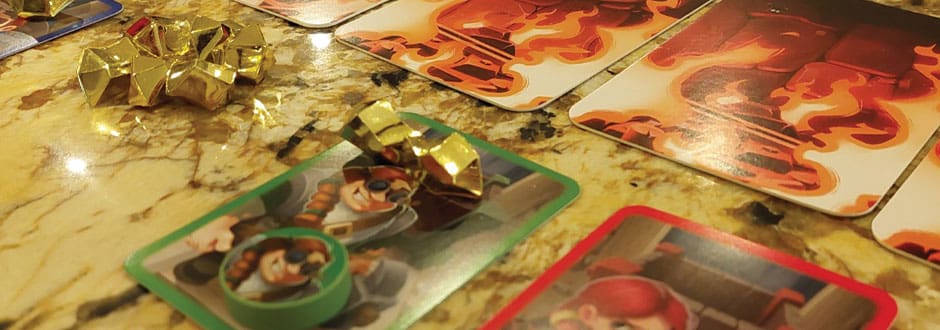
My Gold Mine is a fast-playing push-your-luck card game for 2-6 players where you are miners trying to collect as much gold as you can before Dragobert the dragon catches you!  

Set up! 


This game is really simple to set up – in fact the box itself unfolds as a platform to place both decks. Each player receives a miner card and a corresponding colour miner token. The gold cards are shuffled and placed face-up on the platform and the exit cards are shuffled and face down on the remaining space. Then lay the 9 large card mine track with the final exit card on the furthest left space, the mine cart card in the centre, and the dastardly Dragobert card on the furthest right space. The miner tokens are placed on the mine cart, and the shiny gold nuggets are placed within reach.  


Playtime! 


This game lasts just 3 rounds. Each turn you choose between taking a gold card and an exit card. As well as giving gold, the gold cards will either move your miner 1 space towards the exit, keep you where you are, or move your miner back 1 card towards Dragobert  


If you choose an exit card instead, these show a combination of options; move 1 or two spaces towards the exit, move everybody one space towards the exit, or swap your miner with another player’s elsewhere along the mine cart track. There’s even one card with a very greedy bonus 3 gold on it!  


Whenever a Dragobert card is revealed as the top card of the gold card deck, the Dragobert card slides forwards one space and the card it replaces is flipped to show the fiery flame side.  


If and when you reach the exit, you can’t collect any more gold, but you are safe! Any miners caught by Dragobert are, however, out of the round, and all their hard earned gold cards are worthless! When every miner still left in play reaches the exit, the round is over and the winner of gets 3 nuggets, 2nd place gets 2, and 3rd place gets 1. The game ends after 3 rounds and the richest miner wins!

Final Thoughts! 


We love My Gold Mine. We learnt it in under a minute and our 7 year old son hasn’t stopped asking to play it since! It’s a quick, fun push-your-luck filler game that feels tense but only ever in a super fun, light way. We hesitate for a moment, debating whether to risk mining another gold when the flames of Dragobert’s breath are close. But if it doesn’t work out, we laugh out loud as our miners gets knocked out. The decision space is small and isn’t likely to overwhelm young players. It’s also a great space to see how decision-consequence plays out. So recommended age-wise, it’s on the button!

Although the artwork is cute and cartoony, it is also clever. With the gold deck face up, you know what’s on offer on your turn. But you don’t know what’s underneath – is it Dragobert? Is it more gold? If Dragobert suddenly moves closer, the risk from your two-nugget card suddenly doesn’t seem like such a good idea!

The sliding mine track card mechanism is also a great visual. I can almost feel the heat as Dragobert breathes closer and closer! And the race/reverse race to get to the exit but not waste potential gold mining opportunities is a really fun tug of war. Especially when your opponent either moves you back towards Dragobert or over to the exit, thereby ending your chances of gaining more gold!  


If you’re good at memorising cards, knowing how many Dragobert cards have appeared at any stage of the game can help plan your moves. But, honestly, not doing that and just taking the risk is a lot of fun.  


The components themselves are good overall. The track cards and nuggets are top quality, and the mine cards and gold cards are good too, Our stickers are peeling a little on the tokens, but to be fair we have played it so many times already (and you only really need to know which colour you are in any event), so I’m not worried about durability. I really love that the box itself acts as a place to stack the cards (a feature of their new in-box range apparently!). Oh and I am always a huge fan of magnetic catches! 


Player elimination does happen if Dragobert catches you. And some very young players might not like that. But the time-out only lasts 1 round and it doesn’t feel overly mean. Our son was knocked out of one round early into our first few games. But he just laughed and was determined to send everybody else into Dragobert’s fiery clutches!  The fact we are playing it at breakfast, after school, and after dinner without grumble is a testament to how much everyone in our house is digging My Gold Mine!  


This blog was written by Favouritefoe

Chocolate Factory Review

Life Is Like A Box Of Chocolates

There is very little better in this world than good chocolate! There is a reason why it has become a staple in the world of gifting and why Easter is still in the heart of every atheist. Chocolate releases dopamine and serotonin and other such endorphins that make us feel good and so makes the perfect theme for a board game. 2019’s Chocolate Factory puts us right in the heart of the process and presents us with the process of building, running and developing a factory sometime in the heyday of Chocolate manufacturing.

Wonks-Vision

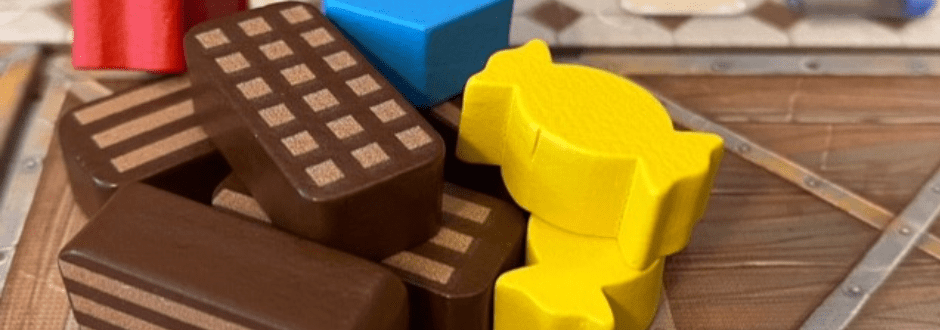
The first thing to point out is the sumptuous looking production. Designed to look like one of the classic factories you might have found in the English midlands in the late 1800s. With dual-layered player boards, gorgeous artwork that really immerses you in the world of the Victorian chocolatier and little wooden chocolates for days! Each type of chocolate has a different little piece.

There are yellow wrapped chocolates, red wrapped chocolates, blue chocolate boxes not to mention two types of Chocolate bar (fingers and chunks). And all that before even mentioning the little cocoa nibs and blocks of basic chocolate. The only disappointing component after all that trouble is coal. With everything else feeling quite deluxe, the coal is represented by simple cardboard tokens. But if that really annoys you then there is a deluxe version that adds lovely little resin pieces to replace them. But I am getting ahead of myself. Let’s talk a little about how the game plays.

A Factory Line

Each player has their own board representing the production line of their factory. The neat little mechanism here is that with every turn that goes by you move little tiles across your conveyor belt gaining a real sense of progress.

The game itself takes place over seven working days with each day made up of a morning, an afternoon and an evening shift. Each round will start with a machine tile and employee draft. You will select a machine upgrade which gets added to empty slots on your production line or can cover an existing tile. These will allow you to perform different actions from turning cocoa into chocolate or processing chocolate into bars or sweets.

However these actions will take coal to run. This makes for an interesting decision when drafting. Do you focus on filling your factory with lots of machines that do small actions or fewer that do big expensive ones. You also get to draft a temporary employee you can have for that one day. They will offer certain power for your shifts that round. One might allow you to use machinery using less coal or others might allow you to create double the amount on a single turn. Each shift of the day will see a cocoa nib entering your factory line.

As they move along the conveyor belt you can burn coal from your personal supply to take actions that create different types of chocolate. Be careful though, every player gets the same amount of coal each day and the only other way to get it is to trash chocolates you have already made, therefore making them unusable for the sales part of the round. Coal is tight in this game so you really have to think carefully about what machinery you do that shift and most importantly the order in which you use them. The drafting system is great as well. At the beginning of the round there will be an equal number of machines and workers for your player count and on your turn you get to choose either one or the other. So deciding whether to take the machine you really want or the employee you really need is a tough decision.

Sales, Sales, Sales!

At the end of each day, any chocolate you have made and has been moved to your storehouse, can potentially be sold. There are two main ways to sell your goods. You will always have three personal contracts which will range from easy, through to medium and up to hard. Each time you have enough to satisfy one you can discard chocolates from your storehouse to get the listed monetary reward. Satisfy the easier ones to get small bursts of income early on or hold out for big payouts later in the game.

Once one is complete you can draw a new one to replace it and so your options are constantly changing. The other option, and perhaps more interesting is selling to the big stores. There will be six cards dealt at the beginning of the game in the central area and each will ask for a different set of chocolates. What is great is there are multiple options here dealt randomly and so each game will have different demands. For each delivery you make of the required chocolates you get to move up that store’s particular track and if you can manage to be ahead of everyone else by the end of the game you get rewarded. For each store there will be a second and first place bonus and so forgetting about them can cost you big time.

Eating It Up

Chocolate Factory is crunchier than it first seems with lots of meaningful decisions to be made along the way. The main actions are simple but deciding how to develop your production line is a really interesting puzzle and based on what contracts come up will dictate which routes you take. This offers so much replayability. Not to mention, moving those tiles along your conveyor belt and getting that sense of movement and progression is so satisfying. You even do what I do and add a little bowl of chocolates to the table to reward yourself for each sweet contract you complete just to be as immersed as possible!

This blog was written by: Dan Street Phillips

Viticulture Review

In 2013 Stonemaier games exploded onto the scene with their debut game Viticulture. Based in the world of Italian wine making, Jamey Stegmaier and Alan Stone presented a worker placement experience that saw you grow grapes, make wine and fulfill contracts as you strived to become the best winery in Tuscany. Counted in many top ten lists, Viticulture has become a modern classic and a must have for any euro game lover. The theme is still pretty unique in the board game world and allows you, if like me, to take advantage of it and demand wine and a cheese board every time you play!

Home Is Where The Wine Is

The basic concept of the game is you are left a winery by a family member, most likely parents, and you are to take over the business. This is represented by red and blues cards. Each card represents one side of the couple who once ran the vineyard. Originally these were called “mamma” and “papa” cards but recently, Jamey Stegmairer released a mix of masculine presenting and feminine presenting characters into both decks in order to escape the previous heteronormative couplings. A real fresh and important move that a lot more publishers need to get on board with! The new cards also showcase much more diversity in the appearance of the characters than in the original. Once you have your cards they will dictate your starting resources. Some might offer a choice whereas others will give you specific things. This very basic asymmetric start means that there is a focus for you at the top of the game. One might mean you start the windmill which rewards you for planting grapes so you might focus on getting as much planted as possible to get those tasty points. And points are everything in Viticulture. The first player to 20 will trigger the last round and so building that point engine quickly will put you in a great position later in the game. So what does building the most successful winery in all of Tuscany look like? Each player will have their own board which will monitor everything they have from vines planted in your fields, to grapes in the crush pads through to your wine cellar. You also have the opportunity to build buildings on your board offering you bonuses. As you get more and more wine in stock you will also need to upgrade your cellar to be able to hold those all important bottles.

Wine Improves With Meeples

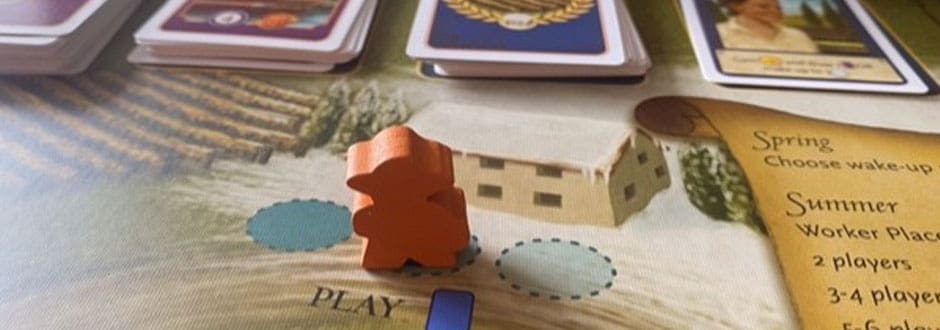
This is a worker placement game at its heart. You will hire your team of workers and send them out into the fields to harvest your liquid gold but what makes this game so fascinating is balancing your pieces between seasons. Each round or year is spread over the four seasons. Spring and autumn offer a small boon, usually card related, but winter and summer hold the main chunk of the gameplay. But here’s the rub. Workers that are placed in summer will not return until the end of the year. This means you have the tension of having enough workers to achieve your goals across both seasons. The other neat twist which has since been replicated in many games is the ‘grande’ worker. Action spaces are tight as only one worker can be at each space. However, the grande worker can go anywhere. Knowing when to use the grande is a big part of the game as you only get to use them once a round. This powerful move can make or break a round quite easily. So you plod along placing your workers on a multitude of spaces in order to get vine cards, plant said cards, harvest grapes and then crush them in order to make wine. All in order to fulfill contracts for money and those important reputation points.

Another key mechanism is the use of visitor cards. There are two types of visitor, one that comes in summer and the other in winter. Collecting and playing these cards can offer big payoffs as well as allow you to take key actions without having to spend a meeple to do so.

Life’s Too Short To Play Bad Wine Games

Viticulture deserves its placement on the vast amount of ‘best of’ lists on which it still resides. It is crunchy but intuitive and offers so many interesting choices whilst also being accessible. The theme hasn’t really been explored far behind this and Vital Lacerda’s Vinhos but it is such a great theme to play in. And if you enjoy the base game then the Tuscany expansion is an absolute must and will offer a series of modules to really at that vital replayability to the game. And if you want to try it in a co-op fashion where you work together on the expansion of your wine empire then the newest edition to the collection, Viticulture World is a brilliant spin on the game.


So what are you waiting for, pour yourself a tall cool glass of pinot grigio, crack out the cheese board and live your best Italian life!

Click here to read more about Viticulture

This blog was posted by Dan Street Phillips

Shop our Full Collection!