SPECIAL OFFER • BUY 3 OR MORE, GET 3% OFF - USE CODE FUN3 • BUY 5 OR MORE, GET 5% OFF - USE CODE FUN5

SPECIAL OFFER - BUY 3 OR MORE, GET 3% OFF WITH CODE FUN3, BUY 5 OR MORE, GET 5% OFF WITH CODE FUN5

Pigs In Blankets Review

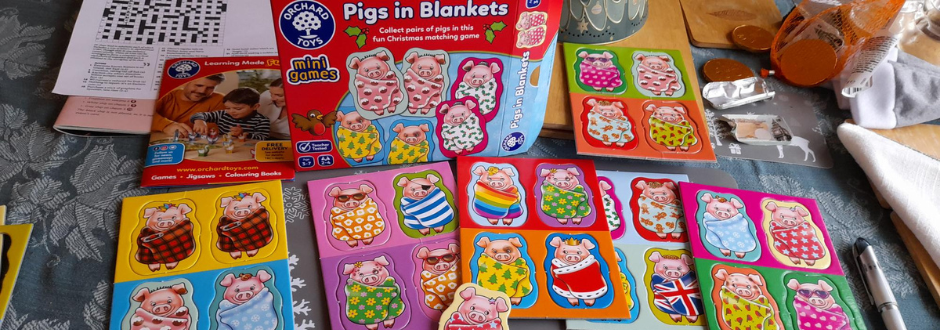
Pigs in Blankets is a colourful, fun, pairs matching game from Orchard Toys in their Mini Games series. The small box is packed full of cheerfully illustrated little piggies wrapped in colourful, fleecy blankets that you have to match up in pairs. And don’t worry none of them gets eaten!

Pigs in Blankets has thirty two cheeky porkers in sixteen pairs each wrapped in their unique blankets of splendid designs. They are made from quality, thick card that can withstand a lot of handling by small hands. Each of the eight two coloured boards holds two pairs of pigs. Pigs in Blankets is described on the box lid as a Christmas game though this seems to be largely because of the punning title’s reference to the Turkey dinner accompaniment and though a few of the blankets are seasonally themed this doesn’t stop the game being an all year round treat.

Pigs in Blankets is basically the mind training game known as Pelmanism. You put out all the cards face down on the table and then each player turns over two of them to see if they can get a matching pair. If they do, they take the pair and have another go. If it is not a match the cards are turned back face down and it’s the next player’s turn. The trick, of course, is to remember where the pigs from unsuccessful attempts lie so you can recall them if you turn up their partner. To this end it is easier if the cards are initially laid out in a regular pattern, say four rows of eight, rather than randomly scattered but this is up to you. Play continues until all the pairs are matched and the person with the most pairs wins.

Pigs in Blankets is a very nicely produced game and makes an excellent little stocking filler or little party game. Whilst you could play the game itself with just a deck of ordinary playing cards this production has a lot of additional benefits. My granddaughter, who is under the suggested minimum age for Pigs in Blankets, still enjoyed matching the cute pictures. She already likes mini jigsaws and enjoyed putting the Pigs back into their cardboard sheets. All the Pig shapes and corresponding holes are the same so you can have a lot of fun either putting the right Pigs in the right coloured holes or mixing and matching them up to make your own variations (as has been shown in the picture).

Orchard Toys produces educational games with the aim to make learning fun and Pigs in Blankets is a perfect example of this as your child will develop shape matching and colour recognition skills whilst enjoying the delightful artwork.

This blog was written by Pete Bartlam
Insey Winsey Spider Review

Insey Winsey Spider climbed up the water spout,
Down came the rain and washed the spider out.
Out came the sunshine and dried up all the rain,
And Incy Wincy spider climbed up the spout again.

Or so it goes in our family, that our lovely little Maya likes to sing along to and do all the actions. It’s known as itsy-bitsy spider in the US and there are other less salubrious versions but not as far as I’ve seen “Insey Winsey” until Orchard Toys brought out this bright package for pre-school children – maybe it’s a copyright thing!

Insey Winsey spider by Orchard Toys is one of their well made, learning made fun games, that promote early skills. In this case developing counting skills, shape matching and observational skills through two different games based on the popular nursery rhyme. Children learn through play and Orchard Toys aim with their offerings to strike the perfect balance between education and fun.

So what do you get with Insey Winsey Spider? First you get 4, two-piece, double sided drainpipe boards. These are very solidly made out of thick card with bright pictures and colours. One side has blank spaces, 10 of them, for your spider to climb by counting the number rolled on the normal dice. The other side has the same layout but now the spaces have shapes in the spider’s colour: Red, Blue, Green or Yellow. You progress up this side by rolling the other dice that has six different shapes on it and then moving your spider up to the next matching shape. Incidentally the shapes are laid out in a different order on each board but that won’t affect progress.

What will affect progress is the weather! This is represented by an attractive, and again solidly made, spinner where a furled umbrella spins around over an alternating backdrop of Rain and Sunshine. After each spider movement you have to spin the spinner. If the sun shines everything is fine and your spider remains positioned in the pipe but if it rains? Well we all know what happens then and your poor, wee spider gets washed out to the bottom! Now I thought that was well harsh, even though the spinner is weighted in favour of Sun with their spaces being almost twice the size of the Rain ones.

My wife, however, has a different view, believing the children will get as much pleasure out of the action of the spider in Insey Winsey Spider being whooshed out, particularly if we’re all singing the song, handily printed out on another stout piece of card. As always, she’s right! The action bits are more enjoyable than the satisfaction of reaching the top.

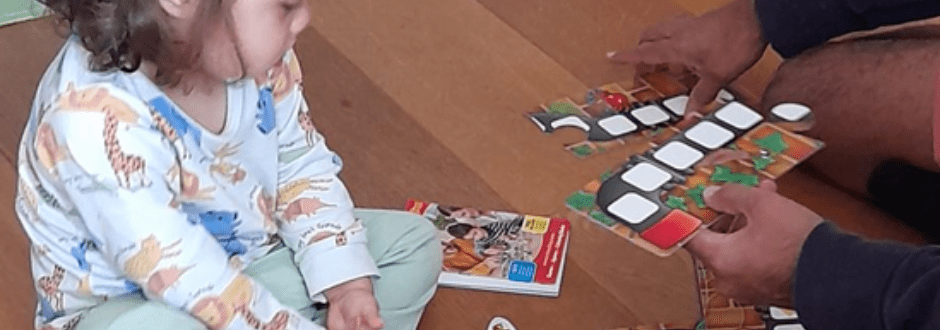
Our granddaughter Maya loves this game and always pulls it off the shelf when she comes around to visit even though she is only 2, one year below the “official” age range of 3-6. What she likes is the boards are like 4 colour-coded, two piece jigsaws and puts them together and plays with the spiders and spinner.

One note of disquiet. For me the spider pieces are the weakest element. Their pictures are fine – cheeky looking, bright coloured and with contrasting coloured tiny wellingtons on their 8 little legs – but they won’t stand up! They’re printed on thick card with an angled slot in the base into which a small piece of card slots to make a stand. This, however, is never gripped tightly enough and falls out even with gentle, adult handling. A solid, wooden piece that would stand on its own on an edge would have been much better. Maya’s also got some wooden Kiwis that we got in New Zealand that are ideal for this but it rather changes the chant.

Incy Wincy Kiwi climbs up the water spout …!

Honeycombs Review

Honeycombs by Gibsons Games is a lovely chunky pattern matching game with super tactile tiles! Yes! If you didn’t already know, Gibsons, the jigsaw puzzle pros, also publish a great range of family games!

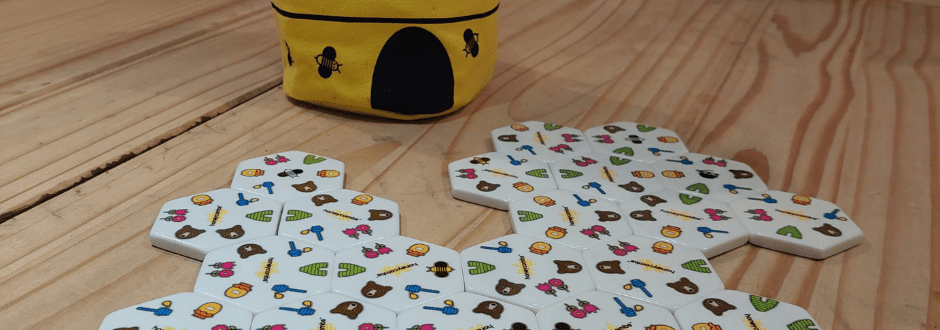
Before I go into the gameplay, I want to give a special mention to the tiles and the canvas bag they come in. The 52 tiles are thick and chunky and lovely to hold. They’re made from urea so feel like porcelain but are way more hardwearing. Plus the little icons are super sweet (like honey!). The canvas bag is also really top quality and brightly coloured. It has no problem standing alongside the cardboard boxes on the shelf next to it.

How To Play

For 1-8 players, Honeycombs is suitable for players age 6 and over. A typical game takes anything from around 15 minutes to 45 minutes depending on the mode you play. And it’s super versatile because you can play Honeycombs competitively, co-operatively, in teams, or even solo!

Whichever mode is in play, however, the goal is pattern matching. Every time you lay a tile, the more symbols you can match when they connect together, the more points you score! The wee bee is wild so can connect to any other symbol. And if you can match all 6 symbols around a hex, that’s worth bonus points!

There are two competitive modes. Firstly, we can race to be first to connect all of our own share of the 52 tiles. In that mode, the winner is the player with the most points at the end of 3 rounds. Any icons that do not match and tiles with only 1 matching symbol won’t score points though so sometimes more speed less haste is the answer!

Secondly, we can compete by placing a tile from our hand of 3 tiles into one big honeycomb. In this mode, some tiles have symbols in the centre that will let you do special things like x2 points for connections to that tile or take another turn (or even steal someone else’s turn!). Points are accumulated as we go.

If competitive combing doesn’t trigger our sweet tooth, we can chill out and go full co-op and just play to see if we can make as many connections as possible together – no pace, no scores, just satisfaction from a well-constructed comb!

Final Thoughts

Honeycombs is a really lovely chill game that can be played in a way that stings! It’s an abstract game for sure. But, having said that, connecting the tiles together does feel like we are creating a honeycomb! As I said above, the artwork is so sweet, and I love holding those heavy, chonky tiles. Turning them around in my hand as I work out where to place it just feels lovely. My son loves competitive and co-op games. And I love playing games with him. So we can go head to head when he’s in the mood to beeee competitive. Alternatively, we can happily work together and chat about life, school, and everything in between as we play.

The Castles Of Burgundy Review

A Rich Burgundian Pleasure

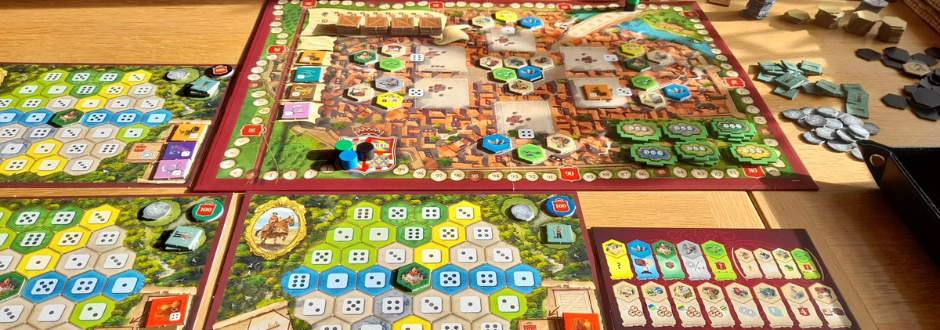
The Castles of Burgundy is a dice-rolling and tile-laying game based on rival Duchies competing for prestige in mediaeval France. Players have their own individual boards representing their Duchy with their castle in the middle. Around this castle they build a town of Castles, Buildings, Monastries, Mines, Ships and Farm land by means of rolling dice. They may also trade in goods as one of the many ways to garner Victory Points.

The Castles of Burgundy is played over 5 rounds with each round having 5 phases. Each player has 2 dice of their respective colour and there is an additional neutral White die. All these dice are rolled simultaneously each phase and are left on show. The White die shows in which of the depots the 1st trade good will be put and each player takes actions dependant on the numbers rolled on their dice. They also have a number of Workers that can be used to modify the die roll. The actions will be to take various hex tiles and put them in their Key holding areas where they can be moved on to their Duchy as a later action. Some of these tiles can be bought with coin. Also goods can be collected by Ships and later sold for coin and VPs. Finally you could hire 2 more workers.

All these actions depend on the number on your dice. As the dice are on display when rolled, this means that early players in the turn order not only get the best choices from the limited tiles on offer but can see what the later players are able to do. As you build up your Duchy each tile will have a specific effect either gaining some special buff or awarding Victory Points now or at game end. After each player has taken their Actions a new phase begins and the dice re-rolled. After 5 Phases the next round begins with all the tiles in the depots being refreshed and a new set of Trade Goods to work through. After 5 complete Rounds the final VPs are tallied and the grandest Duke or Duchess declared!

As well as the standard game you get a lot of different player Duchies to use and there are various extensions with further tiles and the use of optional Shields.

Give The Dog A Beaune

Whilst The Castles of Burgundy is a delight, once you get to grips with it, I had a few little gripes. I found some of the set up rules a bit hard to follow, particularly with respect to the turn order bridge. To clarify, all the players start tokens are placed in a stack at the right hand end of the bridge i.e. furthest from the town centre with the 1st player on the top of the stack and so on down to the last player at the bottom. On all turns, play order is determined by this stack and as tokens move towards the town as the result of a “Ship” tile they will move up the order of play.

The other thing that seemed counterintuitive was to stack the bonus tiles with the bigger one on top of the smaller. Whilst this is OK and is done to get the bigger reward available first, it did offend my slight OCD!

My final small niggle is the smallness of some of the images and, in particular, the numbers on the monastery tiles making them almost illegible. As you need these numbers to reference the effects it would make life a lot easier to have used a larger typeface.

Côte d’Or

The Castles of Burgundy is a golden treasure, straight forward to play (with some looking up of tile effects) quick turn time and plenty of player interaction. The two-sided main board and the many different player mats plus the various extensions give it a lot of replayability. The luck of the dice can be frustrating at times though this is mitigated by the clever use of the Workers. Either way you usually finish a game wanting to go again to try to do it better next time.

Recommended.

This blog was written by Pete Bartlam
Featherweight Fiesta Review

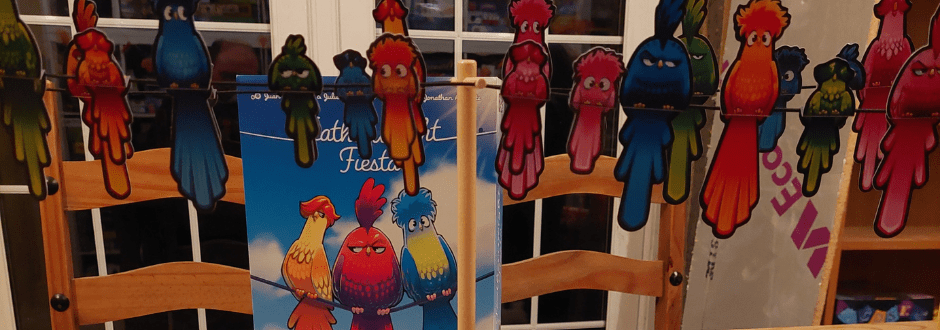
Featherweight Fiesta by Gigamic and Hachette Board Games UK is a colourful game for kids age 7+ that combines dexterity with pattern matching. Games last around 20 minutes and takes place over two phases.

The goal is to make the birds on the telegraph wires match the patterns on the selfie cards which award end game points.

Phase 1 is “PERCH AND POSE” and your turn, you can:

  1. add a bird from the fence to a telegraph wire; or
  2. move a bird from 1 wire to another wire (including pushing other existing ruffled residents along the wire but beware as fallen birds are removed from the game and you might need their preened presence later on!);or
  3. grab an egg for spending on extra bird movements later on.

If have a selfie card showing the same configuration as the wires, you get to flip that selfie card over. And you can do that on any player’s turn. You also get to pick another selfie card from the 2/3/4/5 point value decks. But no matter whose turn it is, you can still only complete one per turn.

When all the birds are up on the wires, phase 2: FLY THE NEST begins.

Here, everyone takes a turn to pull down on the tail of any bird in a group of birds on the wire. The goal is to ping the birds off the wire so that only 1 bird remains – if you do it, you get to try and complete one more selfie card (or grab an egg if you have none left to complete!)

Our son really enjoyed Featherweight Fiesta. Phase 1 was easy to understand, and he loved pinging birds in phase 2!It’s a very light game but the goal cards include different size, breed, and colour birds. Pattern matching is an easy mechanism for younger kids to grasp And dexterity is always popular with our wee gamer.

The components are really nice. The wooden telegraph poles attach to the box (which also acts as the fences for Phase 1) and you can tighten or loosen the wires to suit. Tighter wires are intended to make it more challenging as it can be harder to keep the birds on the wires when they are shuffling around or flying away. But we didn’t find any particular tension level overly tricky. The cardboard birds are also super colourful, and their faces make us all laugh!

You can also play Featherweight Fiesta co-operatively. It feels tricker in a way because you can’t take individual selfies and complete cards whenever you want (or can). Completing cards can only be done collectively when a player uses a special smartphone token.

Having tried both co-op and competitive mode, our son’s favourite way to play Featherweight Fiesta is as a competition. But he is happy to play Featherweight Fiesta either way. And with games lasting only 20 minutes, it’s a great one for after tea before his bird-bath routine begins!

This blog was written by Favouritefoe

Miller Zoo Review

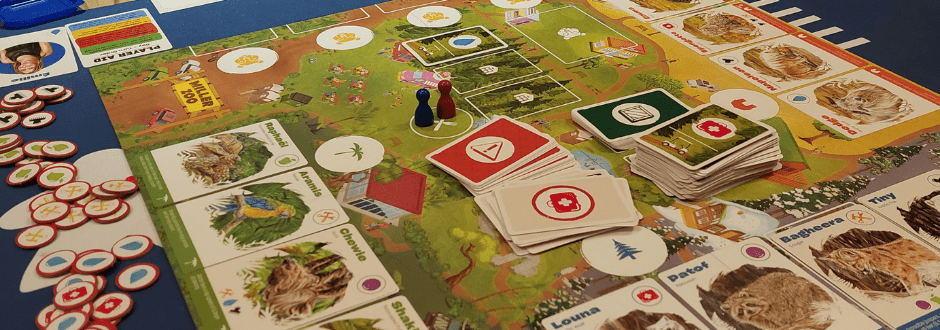
Miller Zoo game is a co-operative game about solving problems at the zoo and welcoming new inhabitants to the enclosures. It is a campaign style, legacy game so that as you win you get to open new content and unlock new challenges!

Based on a real zoo in Canada, we need to help our resident animals thrive! But we only have limited resources and movement. We win the game together if we can house 7 new inhabitants and clear the problems off all the animal cards before the resource deck runs out!

The rules are very straightforward and each round has 4 phases. At “dawn” we each draw resource cards that have a combination of symbols on them. In the “morning” we place problem tokens on our existing resident animals that need resources to clear In the “afternoon” phase we move zookeepers to enclosures to clear off problems with the resources they have. It’s also the time we welcome new inhabitants to spare enclosure spots. When “night” arrives, it’s crisis management time by allocating resources from the deck. However, every resource taken from the deck reduces the time we have to solve the problems coming up. Why? Because the deck also acts as the timer for the entire game! If all the new inhabitants aren’t safely bedded down and the zoo is running well by the time the deck runs out, we win. If not, we try again! If you win, your reward is to open an envelope (6 in total!) which includes new challenges, powers and resources.

Miller Zoo is a great introduction to co-operative play for groups with younger gamers. Actions are simple and the first game is basic. But it gets you used to the rhythm and flow of the game. The campaign adds more challenges that increase the competing priorities slightly but nothing that would take it out of the realm of introductory play. New zookeeper powers and animal cards with more complex needs keep games interesting. But because the basic 4 stages don’t change there will be few new rules to have to learn along the way. This might feel a little limiting for experienced players. But as every game is only around 30 mins, it makes it a great choice when you have a group with kiddos or inexperienced players. Our son is 8 years old and he was able to not only make decisions in this game, but also steer the collective actions. This is a big confidence booster for him and for that we will happily play Miller Zoo whenever he wants!

Ark Nova Review

Who Doesn’t Love Animals?

Theme can be so important when it comes to board games as it enables us to engage in what we are playing and enhances the level of escapism that board games can provide. Sometimes a game comes along where the themes and mechanisms that underpin the game work so well together that even if they are complex and appear unwieldy at first that once you understand what you are doing it comes together to make sense. I believe Ark Nova is one of the best examples I can think of here, where you are both trying to build a zoo that provides both appeal and conservation to try to win the game.

How Exactly Do You Build A Zoo?

In Ark Nova, one to four players will each be building up their own personal zoo from a number of possible map options, building enclosures and populating them with animals before potentially releasing them into the wild. The game features two scoring tracks, one related to the appeal of your zoo and one covering your conservation, and the game will end when one player’s two markers pass. Additionally to these there are two other tracks to be aware of, a reputation track which improves the animals you may be able to take from a central boards and can grant you certain one of benefits when you pass certain points and a break track which moves when you take certain actions or play certain cards, and once this hit the final space will allow players to gain more income, discard cards and replenish the association board along with some other potential benefits.

There are five possible actions you can take in the game and as you play actions they will decrease or increase in strength allowing you to take more powerful actions depending on their value. For example, take the build action at strength one and you can only build a one size enclosure, at strength five you can build a size five enclosure or perhaps an aviary or reptile house if you’ve upgraded your card. These actions are building, associating, sponsoring, drawing cards, or playing animals into your zoo.

Building enables you to place different types of enclosures on your zoo map, which can be followed up with the animals action to play animals into your zoo. Sponsorship action enables you to either break to gain money and move the break marker or play sponsor cards which will have an impact on your zoo giving you perhaps additional end game scoring, a special enclosure for your board, or a bonus at each break. Drawing cards allows you to refill your hand, and often discard cards that you don’t want.

With association, you place one or more of your workers onto a separate associate board to increase your reputation, partner with a continent to help to reduce the cost of playing animals from that region, partner with a university to increase you hand limit or gain additional research icons or reputation or support conservation projects.

If You Build It, The Animals Will Come

The art on the cards are all photographic, which I love but this might not appeal to everyone, while the rest of the art on the boards and cards is clear, although there are a lot of symbols which you will need to learn. The game comes with a huge deck of cards, and for me this is one of the best parts of the game as it means you can’t just adopt a winning strategy and play it every game as you really don’t know what is going to come out. The number of cards can lead to some frustration though, say you’ve built a petting zoo but then you can’t find the animals you want to fill it.

This is a long and complex game, your first game might take up to three hours or even more but once you’ve mastered it I think you can get it down to half that time and I have played it at four players in under two hours. However I think it is also a very approachable game that is worth taking the time to learn. I’ve played this game at all player counts, including the solo mode in the box and except for taking longer with more players the benefit of more players is you get the opportunity to cycle a lot more cards in the deck and can benefit more from other sponsor cards.

Ark Yesva!

I own a large number of games, some may say too many, but after my time with Ark Nova I think it is right up there with the best games I’ve ever played. Even if you don’t win, which I never do at Ark Nova, you can feel a sense of satisfaction at the zoo you have built in front of you. In board games, I’m more than happy to lose if I still feel I’ve achieved something and Ark Nova does this better than most. With the Marine Worlds expansion just coming out as I write this, I believe my love for this game is going to grow. Before this expansion I would score Ark Nova a 10/10, so is it possible for me to increase that score further?

There is just so much to love about Ark Nova, from its action selection system to building up your zoo, to the huge deck of cards and number of maps offering a large amount of replayability. Yes its long and yes it is more complex than many other games but it is deserving of your time and rewards the effort you put into it.

This blog was written by Jacob Dunkley

Loot Review

Loot is a wonderful game. A classic Gamewright card game where you, as the players, are on the open waters, as a band of pirates looking to highjack those fully loaded merchant ships, whilst trying to protect your own merchants at the same time.

What’s In The Box?

A deck of 78 cards, and that is all. You have a combination of merchant ships, pirate ships, pirate captains and the admiral.

For us, it is a game that travels on the road with us very well.

How Do We Play?

The game is for 2-5 people (or in teams in a 6 or 8 player format, but it is not so complicated that that is necessary). 2 people in all honesty is not my recommendation, 3 or more and the game just plays out a lot better.

There are 100 pieces of loot available on board the merchant ships and it is your job to have as much of that as possible by the end of the game.

A player on their turn can either play a merchant ship, a pirate ship or one of the admirals or captains if there are merchant ships in play. The starting player has to play a merchant ship to get the game going. If the player of the merchant ship (owner) has not had a pirate attack it by the time their next turn comes around, that player wins it. If the ship is attacked then the battle for the ship is on. Pirate ships are used to attack and they contain skull symbols to demonstrate their power. If a player who plays a pirate gets to the highest skull value when it comes back around to their turn, they win that merchant ship. This can go back and forward as more and more pirate ships can be added to fight over the merchant ship. It has to be a clean round for the winner to claim the merchant. If the pirates are drawn for power, keep battling until there is an out right winner. The pirate captains and the admiral trump all. It is important to note that there are 4 different pirate colours, when battling over a merchant, you can only use the colour pirate you started with. You may run out of that colour and that is just hard luck.

Why We Love Loot

This is a game that frequently travels with us because it is small and quick to play. Whether sat in the airport, a coffee shop, in a caravan you don’t need much space to play a good game.

It is a great theme with the pirates. I know my children will love this one and it is likely my eldest won’t be too far away from being able to play this one (they are young at the moment). It is an excellent game for building quick mental arithmetic for children.

There are very few drawbacks for the game as I would say it if for anyone. Arguably if you are a heavy serious gamer perhaps not the one for you. A great game to end a night on as well.

Final Thoughts

A fast-paced card game that does not take up too much time. We love this one in our house and is a regular to the table top when we are hosting friends who are not gamers. It’s easy to pick up and provides a lot of laughter.

This blog was written by David Ireland

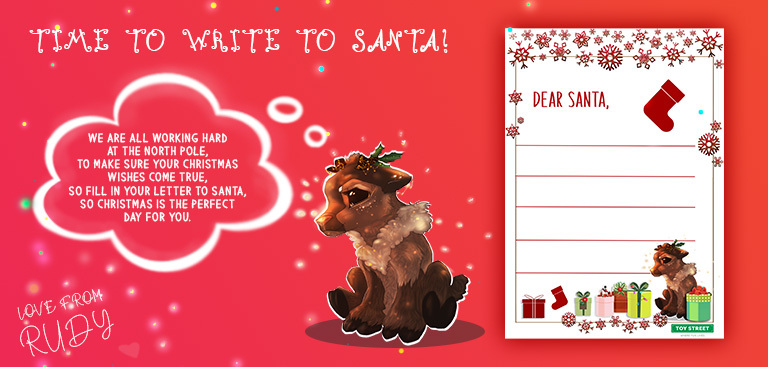
Dear Santa Letter

Dear Santa…


That time of year is coming up where we hang our stockings, write our Christmas cards and place the star on the top of the tree. With 45 days and counting until Christmas, writing up your Christmas wish list needs to be done. With that Dear Santa Letter Week is here, so to celebrate we have created our Dear Santa letter for you and your children to write up and send off to Santa. 

Download your own Santa Letter

Meet Rudy, one of Santa’s reindeers she has traveled far and wide from the North Pole to help out right here at Toy Street in making sure that all of your Christmas wishes make it to Santa’s list! So why don’t you send in your Christmas wishes to us and Rudy will make sure they all get delivered.

Send in your letters to Santa’s Grotto at Toy Street, Bowthorpe Main Centre, Unit 15, Norwich NR5 9HA or email it to us. You can also send them to us on Twitter or Facebook.

We can’t wait for all of your letters, Rudy is very excited to be able to bring them to Santa!

Love Toy Street x